
FAND
GDP says what a place earned this year; FAND shows what it owns (roads, farmland, forests, people's skills) and whether that stock is growing or being spent down.
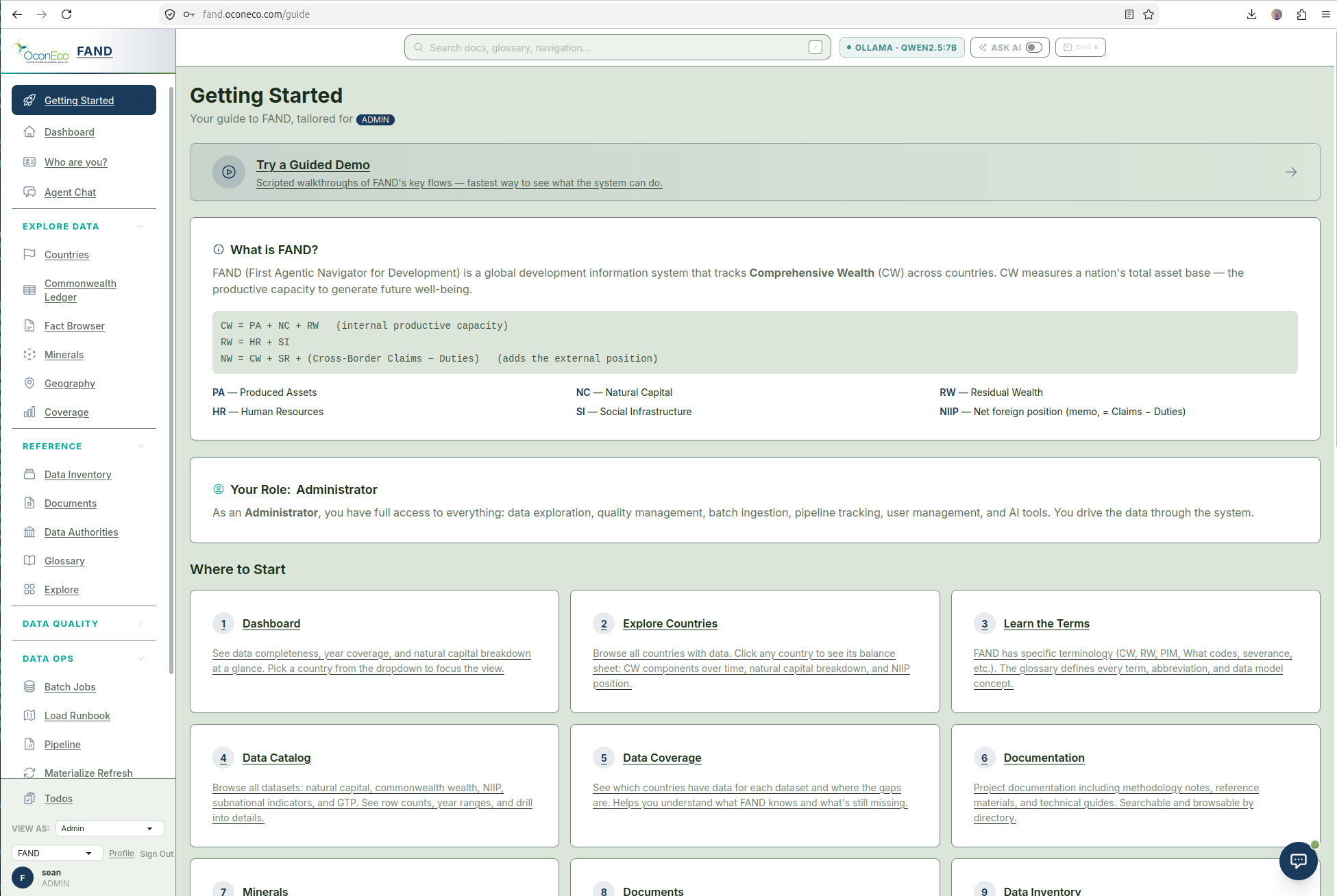
FAND is a web tool that builds a balance sheet for a country, a US state or a US county. It adds up what the place owns in buildings and machinery, in nature, and in people’s earning power, and subtracts what it owes the rest of the world. That makes visible wealth that GDP leaves out, and lets you compare one place with another.
Facts as of 14 November 2026. Each figure below carries its own date.
What you can do
- Look up a balance sheet for any country, any US state or any US county, and download it as a CSV file.
- Compare two countries, or two US counties, side by side.
- Click any number to see its year, its source table and the job that computed it.
- Test a ranking. A sensitivity view shows how rankings and signs change when you pick a different method (the switches).
- Check coverage year by year, to see where the data is thin before you rely on it.
- Ask the in-app assistant to walk you through a calculation.
Example questions:
- How much of this county’s wealth is in its people and its ground, rather than in buildings and machines?
- How does this county’s balance sheet compare with its neighbor’s?
- Which places change rank if we change one method choice?
How we know
The terms, in plain words. Four kinds of capital add up to a place’s CommonWealth:
- PA (Produced Assets): buildings, machinery, roads, the physical things people built, per capita.
- NC (Natural Capital): land, forests, minerals, oil and gas, fisheries and water power, valued per capita.
- HR (Human Resources): the present value of what the working-age population is expected to earn over their lives, per capita.
- OSR (Other Substantive Rights): the rights and institutions (law, markets, trust) that let people use the other three.
DM (Deferred Maintenance of Trust): OSR is valued at no less than 20% of CommonWealth; where the residual estimate falls short of that floor, the shortfall is booked as a liability, DM. Net worth (NW) is CommonWealth plus what the place is owed by the rest of the world, minus what it owes. The balance-sheet identity is the rule that the parts add up exactly to the total at every place and year. In the US snapshot listed under Demos, the four parts of the 2025 column sum to the total shown (checked 14 November 2026).
Scale. The geography table holds 237 countries and economies, with the balance sheet running 1950–2025; how many have each figure varies by component. It also holds 56 US states and territories (50 states, DC and five territories), about 3,149 US counties and 78 Puerto Rico municipios. There is nothing below county level, and no non-US subnational data. (As of 14 November 2026.)
Data sources. Among others: World Bank (WDI and WPP extracts), IMF (IIP and WEO), BEA, Census, USGS, USDA ERS, FAOSTAT, FRA2025 forest data, BLS QCEW, MSHA and OECD. Source lists and agencies are on the methodology pages Sources and Sources by agency; Replication explains how to rerun the numbers.
How figures are checked.
-
The balance-sheet identity must close at every place and year, and automated checks run on every data refresh: the balance sheet adds up, no natural-capital stock is negative, and cross-border totals are checked against the IMF’s own published totals.
-
Each figure carries a pedigree; see NUSAP-lite. Each product says whether a named reviewer has vetted it; see Off the shelf.
-
The demo pages show OconEco’s published Country Pages. The app is moving those figures into its own pipeline: 48 of 118 families of figures so far (14 November 2026).
Directions for Further Work. National natural capital after 2023 is flagged, and hydropower awaits an update. Cross-border claim-rights and duties carry known differences in source vintage. County-level natural capital is partial.
Badges. Each demo page carries a maturity badge: Production, Experimental or Prototype. What each means.
Access. The working app needs a sign-in and is open by invitation during the beta. Inside it you get web pages with CSV export, a REST API, and an MCP server (the standard way AI assistants call tools), both using a personal token. The pages in the demos list are public snapshots of what the app produces.
What you get
- The decision it supports. How a country, state or county’s wealth is built up, and whether it is being drawn down. GDP is a yearly flow and cannot show that. FAND measures; it does not recommend policy.
- What it complements. The World Bank’s Changing Wealth of Nations dataset stops at country level and uses secondary sources for several components. FAND adds state and county levels and recomputes from primary sources. It does not replace GDP.
- Time saved. An analyst who would assemble a county balance sheet by hand from BEA, Census, USGS and USDA tables gets about 3,149 counties and 237 countries in one consistent structure, with a source trail for each number. We have not measured hours saved.
- Price and what a buyer receives. Pricing is not published yet. Request access and tell us what you need; we will reply by email.
How it fits with the other tools
FAND measures what a place owns. CivicStrata goes inside a county, to the neighborhoods and the people who govern them. Corpusminder holds the FAND document library that FAND’s assistants search. SAMlytics shows one of the ways new money can come in: federal contracts that local businesses can win.
Access is by invitation during the beta — you'll sign in with the Google, Microsoft, or GitHub account we invite.
Demos
- US CommonWealth ledger Production — A snapshot of the United States balance sheet, generated 29 October 2026: PA · NC · HR · OSR · DM · NW, every ten years from 1955 to 2025. A frozen exhibit, not a live query.
- Where-Tree explorer Experimental — The world and its 237 economies, then FAND's crude estimates for the places within them. Each place is read by two ratios, people per km² and income per capita, and by the population-weighted quintile it falls in.
- FAND Explorer Prototype — An early sketch of a navigator across the balance-sheet items. The working app has its own explorer, which needs a sign-in.
- FAND's switches — Where FAND keeps two defensible choices side by side (currentness, prices, human resources, the floor under Other Substantive Rights, the premium's yardsticks, who counts as resident) and why each matters.
- Main Street Millionaires Experimental — The FAND entry for wealth advisors: a county income statement by industry, and three flows — corporate surplus, wages, Main Street income — across the county line.