
Corpusminder
Search a large pile of documents by meaning, and see exactly why each result matched.
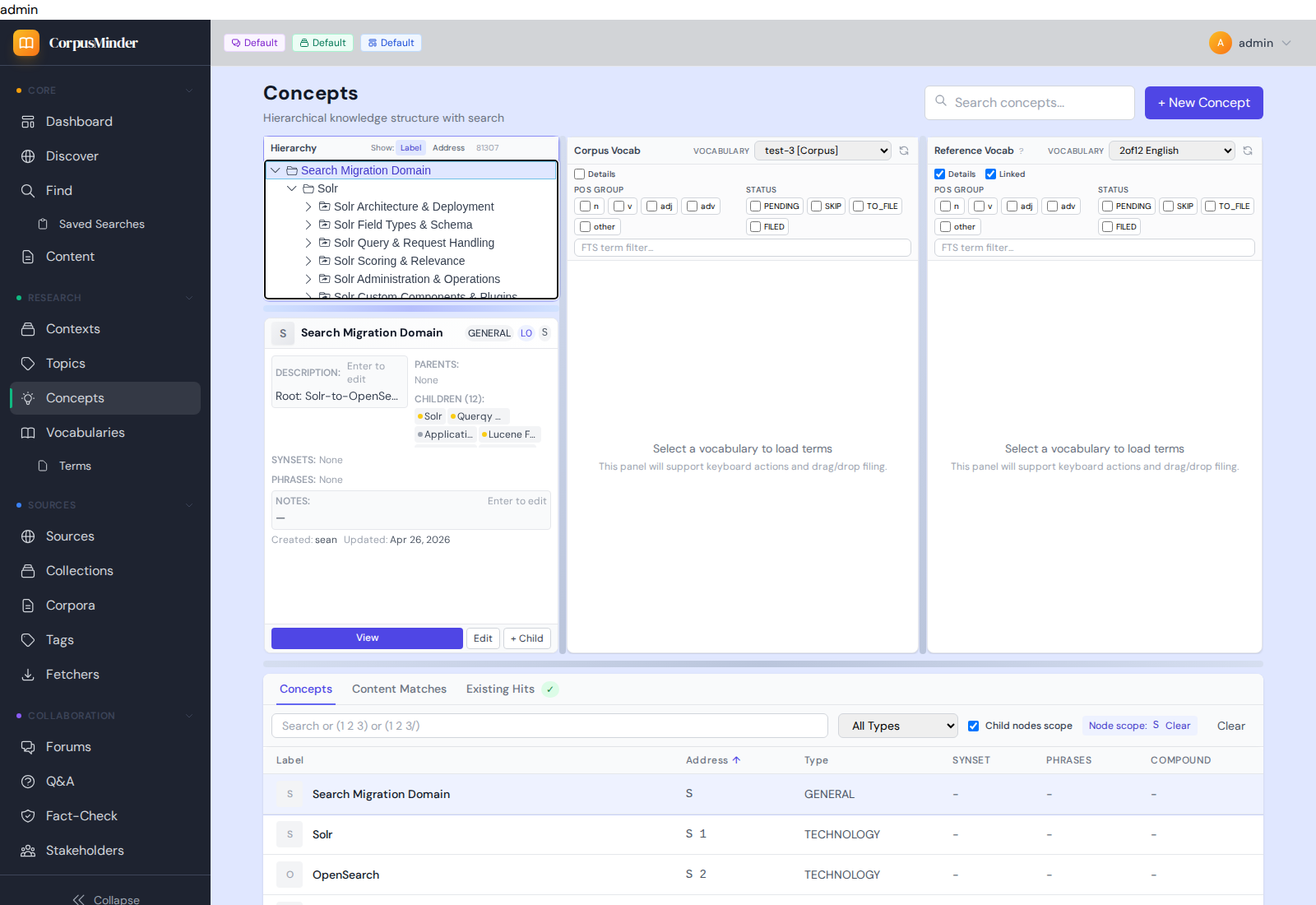
Most search tools hide how they chose what you read. Corpusminder makes that choice visible and shareable, so two people who disagree can at least agree on what they are reading. It breaks each document into small pieces, tags the pieces with topics from a curated topic tree, and keeps a record of which rule produced each tag.
Facts as of 14 November 2026. Figures come from our development instance, not the invitation-only service, and each carries its own date.
What you can do
- Bring in documents. Upload a file or a zip, send text that another application has already extracted, point it at a folder, or import GitHub issues and questions.
- Search by keyword, by meaning, or both. Meaning search finds passages about the same idea in different words.
- Browse by topic. Walk a concept tree and see every document that touches each topic, or ask for the documents that match a topic, or two topics near each other.
- Keep the trail. Each tag records the document, the matched term and the version of the topic tree that produced it.
- Ask a research assistant a question and have it answer from the document collections.
- Discuss in forums that hold questions, answers and evidence.
Example question we ran on the development instance on 14 November 2026: what is the net worth of a county? Searched by meaning across the FAND document library, the top results came from the FAND guide.
Corpusminder is built for questions such as what do the county’s planning documents say about the port? or what was said, and on what evidence, in a rezoning dispute? The development instance does not hold collections like those yet.
How we know
Scale (development instance, 14 November 2026). 10 collections, 9,527 documents and 201,848 searchable pieces. Of those pieces, 193,057 (95.6%) have a meaning-search vector (model mxbai-embed-large, 1,024 dimensions). Five of the 10 collections have none, so meaning search covers the collections we have prepared, not yet every collection. Almost all of the content is FAND doctrine, code and documentation.
What a tag records. The matched term, the part of the document searched, the version of the topic tree and the version of the analysis. On 2 November 2026 those fields were 100% filled on the development host. The same inputs and the same topic-tree version give the same tags for keyword rules; phrase and meaning-based matches are not yet fully covered, and meaning-based hits do not record which model produced them. A tag points to its document and does not always point to the passage: in one collection on 15 October 2026, 2,375 of 2,378 tags did not.
What is measured, and what is not. We compare embedding models on retrieval quality. The best mean recall at 10 results was 0.394 over 28 queries (15 October 2026), and the report rates its own confidence low to moderate. We publish no accuracy figure, because no accuracy test on a named task exists yet.
Speed. Keyword search returned five results in 0.09 seconds. Meaning search is not yet interactive on the development build: 64 seconds for one five-result query, and 26 and 33 seconds for the combined mode (14 November 2026).
Who sees what. A collection is private to its owner unless shared. Sharing is a per-person grant to view, and an application’s key sees only collections marked shareable with applications.
Access. Three ways in: a web interface (invitation-only, behind a sign-in), a REST interface with a key for each application, and MCP (the standard way AI assistants call tools). Personal AI connections through single sign-on are read-only.
What you get
- The decision it supports. What do our documents say about this, and can I defend that answer? A reviewer can see which sources and which rules produced it.
- What it replaces. Re-reading large document sets by hand, or keyword searching a shared drive and hoping the right file matches.
- Time saved. We have not measured it. We would rather time one real question, done by hand and in Corpusminder, and publish both timings with the date.
- Where your data lives. On OconEco’s own hosts, private by default.
- Price and next step. Pricing is not published yet. Ask for a walkthrough and we will reply by email.
How it fits with the other tools
FAND, CivicStrata and SAMlytics each answer a question about a place. Corpusminder organizes documents. FAND’s assistants search the FAND document library held in Corpusminder. SAMlytics is built to send federal contract notices to Corpusminder and read topic matches back (that daily push is switched off by default). CivicStrata can show topic dossiers that Corpusminder produces; it sends nothing in return.
Access is by invitation during the beta — you'll sign in with the Google, Microsoft, or GitHub account we invite.